
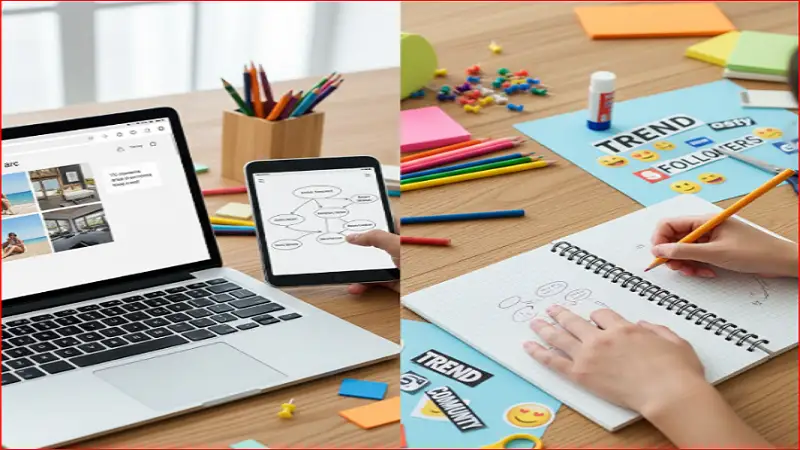
We have all been there: staring at a blank white screen, the cursor blinking like a taunting heartbeat, while a heavy essay requirement looms over us. For most students, academic writing feels like the antithesis of creativity. It’s often viewed as a rigid, soul-crushing exercise in following rules rather than an opportunity to express an idea. However, if we shift our perspective and treat an essay like a DIY craft project—a piece of art built with words instead of glue and glitter—the process changes entirely. Transforming a “boring” assignment into a storytelling masterpiece doesn’t just make the work more enjoyable; it actually results in higher grades because engaged writers produce more compelling, human-centric arguments.
The transition from a dry academic paper to an immersive narrative starts with the tools you use to build your foundation. Intuitive outlining tools and dynamic creative editing platforms and even practical tools like pdf to jpg converters that transform static documents into flexible, shareable visuals—each step shapes how your ideas evolve. Just as a crafter might look for a specialized kit to start a complex project, a student might look for a reliable assignment helper website like myassignmenthelp to understand the technical blueprints of a high-quality paper. By using these professional resources to handle the structural “heavy lifting,” you free up your mental energy to focus on the creative storytelling elements that make your writing stand out. Think of it as hiring a professional architect to ensure the house is sturdy so that you can focus on the beautiful interior design and the “story” the home tells.
1. The Psychology of the “Blank Page” Phobia
Before we dive into the “how-to,” we must understand why essays feel boring in the first place. Traditionally, school teaches us that essays are “objective.” We are told to remove our voices, stay detached, and use third-person perspectives. While this is important for scientific journals, it often acts as a creative barrier for 12th-grade students and undergraduates.
When you sit down to start a craft project, you usually have a visual goal. You see the finished scarf, the painted canvas, or the wooden birdhouse. In writing, we often lack that visual anchor. To fix this, you must treat your outline as a “Sketch.” Professional artists never start a painting without a charcoal sketch; why should a writer start without a narrative map? By “sketching” your arguments as story beats rather than bullet points, you activate the creative side of your brain, making the actual writing process feel less like a chore and more like an unfolding mystery.
2. The “Craft” of the Narrative Hook
In the world of DIY and home decor, the first thing that catches the eye is the “curb appeal.” In an essay, this is your hook. Most students start with a generic statement like, “In this essay, I will discuss the impact of the French Revolution…” This is the academic equivalent of painting a masterpiece in beige. It’s functional, but it’s forgettable.
To turn this into a storytelling project, you need to start with a “Scene.” Whether you are writing about historical revolutions or the biological process of photosynthesis, find the human (or living) element. Describe the tension in the air of a Parisian square or the microscopic “solar panels” of a leaf capturing a beam of light on a summer morning. By painting a physical picture first, you pull the reader into your world. This creates spatial reasoning in the reader’s mind, a technique often used in arts and crafts to help people visualize a finished product. When a reader can “see” your topic, they are much more likely to believe your argument.
3. Building Your “Character” (The Thesis Statement)
Every great story has a protagonist. In a creative storytelling essay, your thesis statement is your main character. It needs to have a mission, a conflict, and a eventual resolution. Instead of a flat statement of fact, give your thesis an “active” role in the narrative.
If you are writing about climate change, your thesis shouldn’t just say “it is happening.” It should tell the story of a changing planet and the “conflict” between human industrial progress and environmental preservation. When you treat your argument like a character arc, the rest of your essay becomes the “journey.” Each body paragraph is a new chapter where your character (the thesis) faces a challenge (a counter-argument) and overcomes it with the “weapon” of evidence. This narrative flow keeps the reader moving through your points without getting bogged down by repetitive data.
4. Exploring Modern Themes: Social Media and Beyond
As we move further into the digital age, the topics we write about are evolving to reflect our daily realities. Many students today find themselves exploring Social Media Essays Topics because these subjects naturally lend themselves to storytelling. Whether you are analyzing the “curb appeal” of an Instagram aesthetic or the narrative “hero’s journey” of a viral TikTok creator, these modern themes allow you to use your personal experience as a creative lens.
Using these relatable topics makes the research phase feel less like a library chore and more like a deep dive into a world you already inhabit. When writing about social media, you aren’t just citing statistics; you are documenting a cultural shift. This is where the “craft” becomes social commentary. By weaving personal anecdotes about digital fatigue or the dopamine hit of a “like” into your academic framework, you create a paper that feels alive.
5. The “Assembly Line” vs. The “Creative Studio”
To reach a high word count without “fluffing” the text, you must treat your essay structure like a professional DIY assembly line. However, the secret to high-ranking content is to keep the “Creative Studio” mindset alive during every step.
- The Skeleton (The Outline): This is your wireframe. Without it, your “craft” will collapse under its own weight. Spend 20% of your time here.
- The Texture (Evidence and Examples): Don’t just list facts. Add texture by using sensory details. Instead of saying “The economy was bad,” say “Families sat around flickering candles, calculating the cost of a single loaf of bread.”
- The Polish (The Editing Phase): This is where you sand down the rough edges. A great writer is really just a great re-writer.
If you find yourself stuck at the “Skeleton” phase, don’t be afraid to look for inspiration in the same way you’d look at a Pinterest board for a craft project. Looking at examples of well-structured essays from experts can give you the spark needed to finish your own work.
6. The Sensory Power of Analogies
One of the best ways to keep a 12th-grade reader (and Google’s ranking bots) engaged is the consistent use of analogies. Analogies are the “glue” of creative writing. They take a complex, abstract idea and stick it to something familiar and concrete.
For example, if you are explaining a complex economic theory like “Inflation,” compare it to a balloon being overfilled with air in a small room. Eventually, the space (the economy) can’t hold it anymore. This takes a “boring” concept and gives it a physical shape in the reader’s mind. In 2026, search engines prioritize “Helpful Content.” This means they want to see writing that actually teaches the reader something in a way that is easy to digest. Using storytelling metaphors is the fastest way to achieve this.
7. Overcoming the “Middles”: Maintaining Momentum
The hardest part of any DIY project is the middle. It’s that awkward stage where the glue is still wet, the room is a mess, and you aren’t sure if the finished product will look anything like the vision in your head. Essays are the same. The “Middle-Paragraph Slump” is where most students give up on creativity and revert to “boring” academic talk.
To avoid this, treat each paragraph as a mini-story. Each one should have its own beginning, middle, and end. Start with a transition that acts as a bridge from the previous thought. “Not only did the Industrial Revolution change how we work, but it also reshaped the very fabric of our homes…” This “bridge” keeps the reader walking through your gallery of ideas rather than jumping from one isolated frame to another.
8. When Creativity Meets Technicality
There is a point in every craft project where the “fun” part meets the “technical” part. In woodworking, it’s the precise measurements. In sewing, it’s the tension of the thread. In essay writing, it’s the citations, the bibliography, and the adherence to a specific style guide (APA, MLA, or Chicago). This is usually where students lose their creative momentum and start to feel overwhelmed.
To prevent “Academic Burnout,” separate these tasks. Spend one day being the “Artist”—writing the story, the descriptions, and the arguments. Spend a different day being the “Technical Assistant”—checking the facts, the spelling, and the citations. If the technical side becomes too overwhelming—especially with complex formatting requirements—this is the perfect time to lean on a resource like myassignmenthelp. By letting the experts handle the technical formatting and structural integrity, you ensure your creative “art” isn’t disqualified by a misplaced comma or an incorrectly cited source.
9. The Importance of “White Space” and Readability
In design, “white space” is essential for making a room feel breathable. In writing, readability is your white space. If you present a reader with a “wall of text” (a paragraph that takes up an entire page), they will mentally check out.
Break your ideas into smaller, digestible chunks. Use bullet points for lists. Use subheadings to act as signposts. This doesn’t just help the human reader; it helps search engines understand the “hierarchy” of your information. A 1,400-word article that is well-organized will always outrank a 2,000-word article that is just one long, dense block of text.
10. Conclusion: Crafting Your Future
Turning a boring essay into a storytelling project is a skill that will serve you far beyond the classroom or the university lecture hall. Whether you are writing a business proposal, a cover letter for your dream job, or a blog post for a site like lwmfcrafts.com, the ability to weave a narrative is what makes people stop and listen.
In a world increasingly filled with AI-generated, robotic text, the “Human Touch” of storytelling is more valuable than ever. Next time you are assigned a topic that feels dry, don’t just “write” it. Craft it. Build a world, introduce a conflict, and lead your reader to a satisfying, thought-provoking conclusion. Your grades will improve, your stress will decrease, and you might just find that writing is the most rewarding “DIY project” you’ve ever tackled.
About The Author
Lucy Wilson is a dedicated education consultant and creative strategist for MyAssignmentHelp. With a passion for bridging the gap between academic rigor and creative expression, Lucy focuses on helping students transform complex assignments into engaging, meaningful projects.
See More