
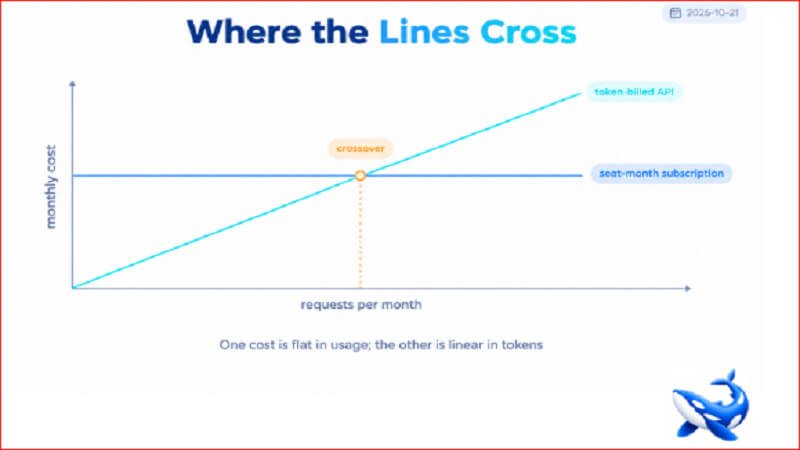
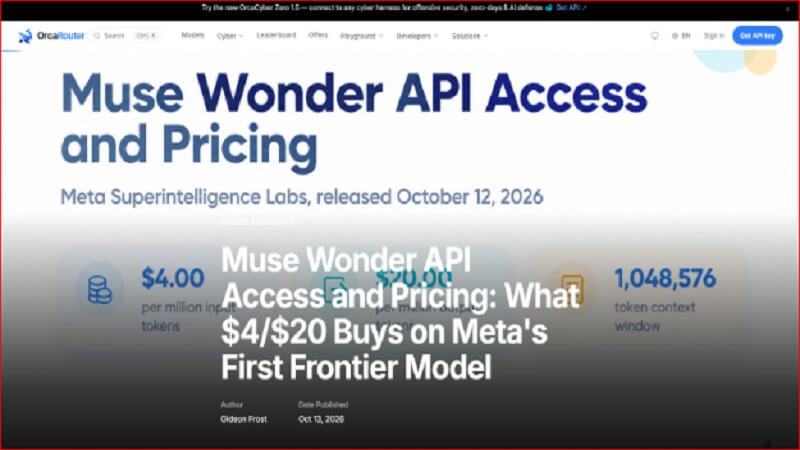
The OrcaRouter muse wonder pricing write-up records two ways to buy the same model series, and they are denominated differently enough that comparing them requires arithmetic rather than a price table [VENDOR: the vendor’s published rates and plans].
The API checkpoint bills $4.00 per million input tokens, $20.00 per million output, and $0.20 cached. The Full Checkpoint bills $50 a month for power usage and $200 a month for maximum usage, with no per-token price published at all.
The temptation is to call the subscription expensive—$50 against a few cents a call. The temptation is wrong at any volume above trivial, and the interesting work is finding where the two lines cross.
Why the comparison is not “per token versus per month”
A subscription bundles a quantity that the vendor does not state. Without a published request or token allowance, the per-unit cost of the subscription is unknowable from the outside, and any claim that it is “worth it above X calls” rests on an assumption the vendor has not confirmed.
What can be computed is the other side: what a given number of calls costs on the API checkpoint, given a stated workload shape.
Take a request of 20,000 input tokens and 1,500 output tokens—a mid-sized prompt with a short answer, the shape of a coding-agent turn.
- Per call: 20,000 × $4.00 ÷ 1,000,000 = $0.08 in, 1,500 × $20.00 ÷ 1,000,000 = $0.03 out. Total $0.11.
- With a cached prefix on the input side at the $0.20 rate, the input line falls to $0.004, and the call costs $0.034.
At ten thousand calls a month, that is $1,100 uncached, or $340 with a cache hit [OURS arithmetic on VENDOR rates]. Which is to say the $50 subscription is cheaper than the API checkpoint at ten thousand calls—but the subscription buys Full, a different checkpoint, so the comparison is not like-for-like at all.
That is the crux. The two doors do not sell the same thing at different prices; they sell different checkpoints under different billing models. The only honest comparison is between the value you get from Full and the value you get from the API checkpoint, and the price difference is one input into that, not the answer.
What the vendor’s own table says about the difference
The vendor publishes a benchmark table covering both checkpoints at maximum reasoning settings [VENDOR], and it is the only scoreboard that covers Full at all.
The table’s promoted rows are the sustained-agent ones—long-horizon software tasks—where Full leads the comparison set. The awkward part is internal: the two profiles trade rows. Full is not uniformly ahead, which suggests two training objectives rather than one model scaled up.
The independent evaluator reads Full at 56 and the API checkpoint at 52 on its own composite at maximum effort, against a vendor figure of 59.0 for Full [INDEPENDENT and VENDOR, respectively].
So the gap between the two checkpoints, on the independent board, is about four points. Whether four points is worth $50 a month or $200 a month depends entirely on what those points buy in your workload, and the vendor’s own trading-rows pattern says they do not buy a uniform improvement.
The line that is worth more than four points
There is one published property of this model that is more valuable than the score gap for a specific class of workload, and it appears in the rate card rather than the benchmark table.
The input price does not step at a token threshold [VENDOR]. A 400,000-token prompt bills at the same per-token rate as a 400-token one. Several flagships re-price the entire request once a prompt crosses a documented boundary, which makes long-prompt work disproportionately expensive on those models.
Consider what that means at scale. A retrieval pipeline sending 300,000 tokens per call is billed at $4.00 per million on this model, or $1.20 per call. On a provider that re-prices the whole request above a threshold—say at double the rate once the prompt crosses 200,000—the same call costs $2.40. Across a thousand calls a month, the flat curve is worth $1,200.
On a workload of that shape, the flat curve is worth more than the four-point score gap and more than the difference between the two doors. It is the single most consequential line in the rate card, and it is not a rate.
What the mandatory reasoning costs
The second property that shapes a bill without appearing in a rate card is the reasoning control: an effort ladder from minimal to max, defaulting to medium, with no off switch [VENDOR].
There is no way to tell this model not to think. Every request spends reasoning tokens, and reasoning tokens are output tokens billed at $20.00 per million.
For a task that benefits from deliberation—a code migration, a long-horizon agent plan—that is the product working as intended. For a task that does not—classification, extraction, routing—it is a fixed overhead on every call, and it changes the arithmetic above. If a 1,500-token answer carries 2,000 tokens of reasoning behind it, the output line rises from $0.03 to $0.07 per call, more than doubling the bill on the same input.
That is the kind of property a buyer has to know before comparing a price, and it is invisible in any table that lists input and output rates side by side.
Where OrcaRouter fits, and where it does not
It is worth stating the catalogue position plainly, because every article about a model should say whether the model can actually be called from the place it is being read in.
Muse Wonder is not available through OrcaRouter [OURS]. The Meta catalogue page carries Muse Spark 1.1 and Muse Spark 1.2 at $1.25 input, $4.25 output, and $0.150 cached, with a 1M context window, and those are different models from the Wonder series.
That is not a gap being papered over; it is the honest state of the catalogue on 2026-10-21. A reader who wants Muse Wonder today goes to the vendor. A reader who wants a token-priced Muse model on a gateway has Spark.
The Spark rates are still a useful reference: $1.25/$4.25 is roughly a third of Wonder’s $4.00/$20.00 on input and a fifth on output, with a comparable percentage cache discount. So the gap between “a Muse model on a rate card” and “this particular Muse model on a rate card” is wide, and it is a gap in model capability rather than a gateway markup—the gateway adds nothing to either.
How to price a two-door purchase
Four steps that survive the missing allowance.
Estimate your calls per month and your tokens per call. Without those two numbers, neither door can be priced. The subscription’s flat $50 looks cheap against a high-volume token bill and expensive against a low one, and which you are is a fact about your traffic that only you know.
Compare checkpoints before comparing prices. Full and the API checkpoint trade rows on the vendor’s own table. If your workload is not long-horizon agentic work, the cheaper door may be the better model for you regardless of the score.
Put the flat input curve into the model explicitly. A provider that re-prices at a threshold costs more than its headline rate suggests, and a provider that does not costs less. That difference can exceed the price gap.
Count the reasoning tokens your task does not need. Mandatory reasoning is a fixed multiplier on output cost. A task that does not benefit from deliberation pays for it on every call.
A two-door release is a packaging decision, and packaging decisions are priced by whoever buys them. The vendor has put the higher-scoring checkpoint behind a seat; whether that is a good deal is a function of your traffic, your prompt lengths, and your tolerance for a model that always thinks.
See More