
Here’s the thing about card making supplies: the hobby has a serious accumulation problem. Not because crafters are irresponsible with money — though a good sale can test anyone’s resolve — but because the options are genuinely endless and everything looks useful in the store. A new ink color. A stamp set that coordinates with three things you already own. Cardstock in a shade you don’t have yet. It all makes sense in the moment, and then at some point you look around and realize you have more supplies than you could use in a decade and somehow still feel like you’re missing something every time you sit down to make a card.
The fix isn’t buying less, necessarily. It’s buying more deliberately. Here’s how to think about it.
Start with what you actually want to make
This sounds obvious and is somehow the step most people skip.
Before adding anything new to the collection, it’s worth getting specific about the cards you genuinely enjoy making—not the ones you think you should make, not the ones you admire in other people’s galleries, but the ones you actually sit down and finish. Are they birthday cards with bold color and a lot of layers? Clean, minimal thank-you notes? Seasonal designs that lean heavily on pattern? Soft, romantic styles with lots of texture and dimension?
The answer shapes everything. Someone who loves intricate layered designs is going to need a different toolkit than someone who gravitates toward clean graphic layouts. Both are completely valid — they just pull from different corners of the supply world. Getting clear on your actual preferences before shopping saves a lot of money and a lot of drawer space.
Build around versatile materials first
The supplies that earn their keep are almost always the ones that work across multiple techniques and projects—not the specialty items that only do one thing.
Cardstock is the obvious example. A solid collection of cardstock in your preferred color palette will get used constantly, in every card you make, in ways you can’t fully predict until you’re in the middle of a project and reach for exactly the right shade. It’s not exciting to buy, but it’s the foundation everything else sits on. Invest in good quality here—cheap cardstock that doesn’t score cleanly or bleeds at the edges creates problems throughout the whole process.
Patterned paper is similar. A curated collection of prints and patterns you genuinely love gives you enormous creative flexibility. The key word is “curated”—a smaller collection of papers that actually fit your style will inspire more projects than a massive stack of prints you bought because they were on sale and seemed fine. When you love what you have, you use it. When it’s just okay, it sits.
Good ink is another one of those foundational purchases that’s worth thinking carefully about. Color range matters, but so does performance—how it stamps, how it dries, whether it plays nicely with your other supplies.
Choose tools for the techniques you already love
Tool acquisition is where a lot of crafters go sideways, because tools look compelling even when you don’t have a specific use for them yet.
A better approach: think about where your current projects slow down or frustrate you, and buy something for that. If precise, clean cuts are what you’re after, a good paper trimmer is going to change your whole workflow—straight edges every time, consistent dimensions, and no more holding your breath while you lay a piece down to see if it’s square. If you do a lot of detailed stamping, investing in a quality acrylic block set and an alignment tool will immediately improve your results. If layering and dimension are your thing, a strong adhesive and a good foam tape make the difference between elements that look intentionally raised and elements that just look bumpy.
The goal isn’t a complete toolkit. It’s a toolkit that makes the specific things you love doing easier and more satisfying to execute. That’s a much shorter list than the craft store would have you believe.
Be selective with embellishments
This is where the hoarding can really accelerate.
Embellishments are small, they’re often inexpensive, and they’re very easy to pick up a few of every time you’re shopping. Gems, brads, ribbon, twine, die cuts, chipboard pieces, enamel dots, washi tape—before long you have a whole section of the craft room dedicated to things you bought because they were pretty and haven’t touched since.
The crafters who actually use their embellishments tend to have a narrower collection that fits tightly within their aesthetic. If your style runs soft and romantic, you probably don’t need bold graphic stickers. If you love clean modern designs, intricate lace trim might not be pulling its weight. Getting honest about what actually fits the cards you make—and resisting the pull of things that are just generally nice—keeps the collection functional instead of overwhelming.
A smaller set of embellishments you reach for constantly is worth more than a large collection you have to sort through every time.
Think about how your supplies are stored
Organization isn’t just a tidiness issue — it directly affects what you actually use.
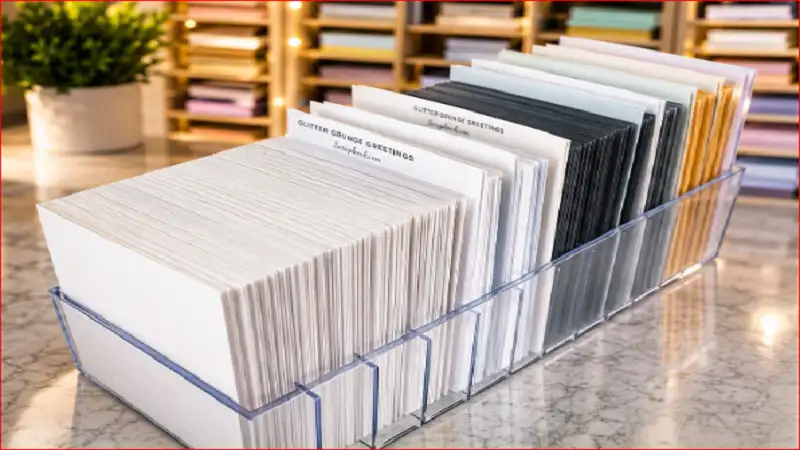
When paper is stacked in a pile, the bottom half effectively doesn’t exist. When embellishments are buried in a drawer, you forget you have them and buy duplicates. When inks are stored in a way that makes it hard to see the colors, you end up reaching for the same few you can identify easily and ignoring the rest.
Visible, accessible storage changes the creative process. Clear bins, upright paper organization, ink storage that lets you see the actual colors — these things make your supplies feel available rather than buried. And supplies that feel available get used. It’s a simple connection, but it genuinely matters.
Let your style evolve without forcing it
A lot of crafters put pressure on themselves to have a defined aesthetic before they’ve had enough experience to actually know what they like.
Style in card making tends to develop through making things—through noticing what feels satisfying to put together, what techniques you keep coming back to, and what finished results make you actually happy. Trying to lock it down too early means you might invest heavily in a direction that turns out not to be yours.
Buy enough to make things. See what you gravitate toward. Fill in from there. The collection will develop naturally, and it’ll develop into something that actually reflects how you work rather than how you thought you’d work before you started.
Make the space itself feel good to be in
This is easy to dismiss as secondary, but it affects how much you actually craft.
A space that’s cluttered, poorly lit, or just unpleasant to sit in creates low-level resistance every time you think about starting a project. You don’t always consciously notice it—you just find yourself doing other things instead. Small upgrades matter more than they seem: good task lighting, a comfortable chair for longer sessions, a workspace that’s clear enough to actually spread out in. None of this has to be expensive or elaborate. It just has to feel like somewhere you want to be.
When the space feels good and the supplies are ones you genuinely love working with, sitting down to make something stops feeling like a project in itself.
Card making is one of those hobbies that can be as simple or as involved as you want it to be, which is part of what makes it so enduringly satisfying. The supplies you build around should reflect that—not the most comprehensive collection possible, but the right collection for the cards you actually want to make.
That’s a much more useful thing to shop for.